
Teachers… you made it!
You’ve survived another year of behavior plans, progress monitoring, mystery stains, lost glue sticks, classroom celebrations, and approximately seven hundred questions that started with, “Can I tell you something?”
The finish line is finally starting to peek around the corner.

The End-of-Year Tug-of-War
And while part of you is already dreaming about sleeping in, summer vacations, and drinking your coffee while it is still hot, for the last two weeks before the end of the year, you’ve probably been stressing about, “What happens to all the hard work my students just did? How do I prevent summer learning loss?”
Because that’s the tricky thing about the end-of-the-school year. You want students to enjoy summer. You want them to rest and be kids and make memories, but you also know how hard they worked to learn those new skills.
You’ve Watched the Growth Happen
> You watched students finally recognize letters they struggled with all year.
> You watched counting finally click.
> You watched confidence grow.
> You watched independence happen little by little.
Nobody wants to feel like all of that hard-earned progress gets packed away with the bulletin boards and classroom decorations.

Keep the Momentum Going
That is exactly why we created our Summer Work Packets. We know sometimes students benefit from (and often enjoy) small opportunities to keep using the skills they worked so hard over the year to build.
Holding Onto Those Wins
Inside each packet you’ll find:
- 40 ready-to-use worksheets
- A mix of math and literacy practice
- Simple directions for independent or small group work
- Answer keys included because you absolutely deserve that
These packets work well for:
- Summer school
- ESY services
- End-of-year review
- Sending home for extra practice
- Keeping routines going without reinventing your week
Three Levels of Differentiation
One of our favorite things about these packets is that they align with our Made For Me Literacy levels. Because we all know classrooms rarely fit neatly into one box.
Some students are still building foundational skills. Some are becoming more independent. Some students are ready for additional challenges.
And usually they’re all sitting in the same classroom.
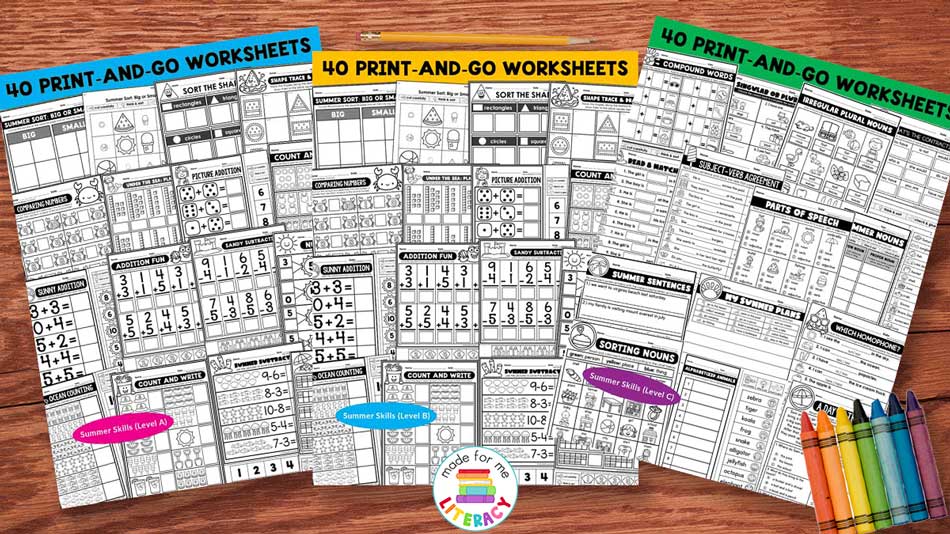
PreK (Level A)
For early learners and students building foundational skills, Level A focuses on those important first building blocks.
Students practice:
- Counting and number recognition
- Matching and sorting
- Shapes and colors
- Early literacy skills like letter recognition and simple questions
Kindergarten (Level B)
Level B supports students who are beginning to build independence while continuing to strengthen core academic skills.
Students practice:
- Counting to 20
- Number sequencing
- Basic addition and subtraction
- Letter identification
- CVC words
- Beginning sounds
First Grade (Level C)
For emerging readers and writers, Level C introduces more problem-solving and expanded literacy skills.
Students practice:
- Addition and subtraction within 20
- Word problems
- Number sense
- Telling time
- Early fractions
- Word families, blends, and writing skills
Why Teachers Love These
Teachers tell us they love having something that feels familiar without adding more work at the end of the year.
They know routines matter. Students know what to expect. Teachers know what to expect… and having one less thing to create from scratch feels pretty wonderful.
The summer visuals keep things fun and engaging while still keeping the focus where it belongs; helping students continue practicing meaningful skills.

A Little Summer Reminder
Sign the end-of-the-year memory books.
Eat the classroom ice cream.
Create those Wacky Links works of art.
Celebrate the wins and the friendships built over the year.
You worked hard this year.
Your students worked hard this year.
And if you’d like a simple way to help continue those important skills through summer school, ESY, or home practice, our Summer Work Packets are ready whenever you need them. We check out all our products for summer learning on Teachers Pay Teachers, or read more about our Extended Summer Year units.


Leave a Reply