
How focused practice can help students build a stronger foundation before moving on to more complex money skills
Money can be surprisingly complicated for young learners. A student may be expected to remember coin names, recognize what each coin looks like, understand that size does not determine value, count different amounts, and eventually use money in everyday situations.
For students in special education and other learners who need more time, repetition, or explicit instruction, all of those demands can pile up quickly. Slowing money instruction down gives students room to understand one idea before another is added.
Start With the Foundation, Not the Finish Line
It is easy to picture the end goal of money instruction: a student independently counting coins or figuring out whether they have enough money to buy something. But there are many smaller skills underneath that goal.
Before students can confidently count mixed coins, they need time to notice coins, compare them, learn their names and features, and understand that coins represent value. Those early experiences are not something to hurry through. They are part of the learning.
The Made For Me Math: Money sequence is built around that idea. Unit 1 introduces coins first. Unit 2 then narrows the focus to pennies. Later units gradually add nickels, dimes, quarters, mixed coins, comparing amounts, and eventually deciding whether there is enough money for a purchase.
Give Students Time to Really Notice Coins
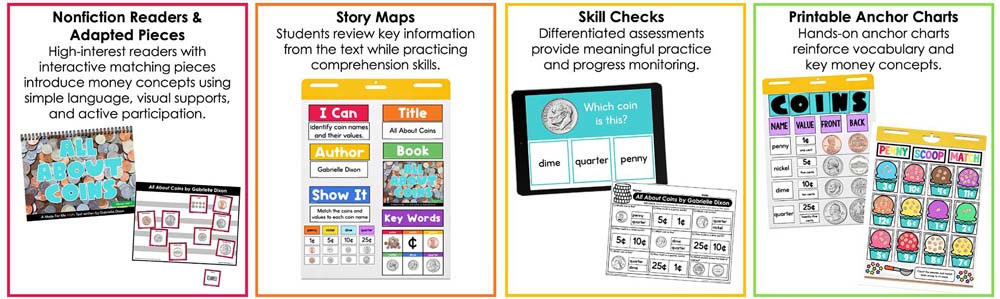
An introduction to coins can be much more useful than simply asking students to memorize four names. Students can handle coins, compare them, sort them, and begin noticing the characteristics that make one coin different from another.
That kind of hands-on exploration gives teachers useful language to repeat: coin, penny, nickel, dime, quarter, front, back, size, color, and value. Students have something concrete to connect those words to instead of learning the vocabulary in isolation.
At this point, the goal is not to see how quickly students can move to mixed-coin counting. The goal is to build enough familiarity that the coins no longer feel like four nearly interchangeable pieces of metal.
Then Narrow the Focus
Once students have been introduced to coins, focusing on one coin at a time reduces how much they have to think about at once. That is where a unit devoted specifically to pennies becomes useful.
Students can spend time recognizing a penny, connecting it with one cent, and practicing the same core idea in several formats before another coin value is added. For a learner who needs repeated exposure, that extra time is instruction, not delay.
This is also where differentiation matters. Two students may be working on the same money concept while needing very different levels of support. One may still need visual choices or matching practice while another is ready to respond with less prompting or work more independently.
Repetition Can Look Different Each Time
Repeated practice works best when students meet the same important idea in more than one way. A lesson might begin together, continue through a hands-on activity or game, appear again in a center, and later become independent practice.
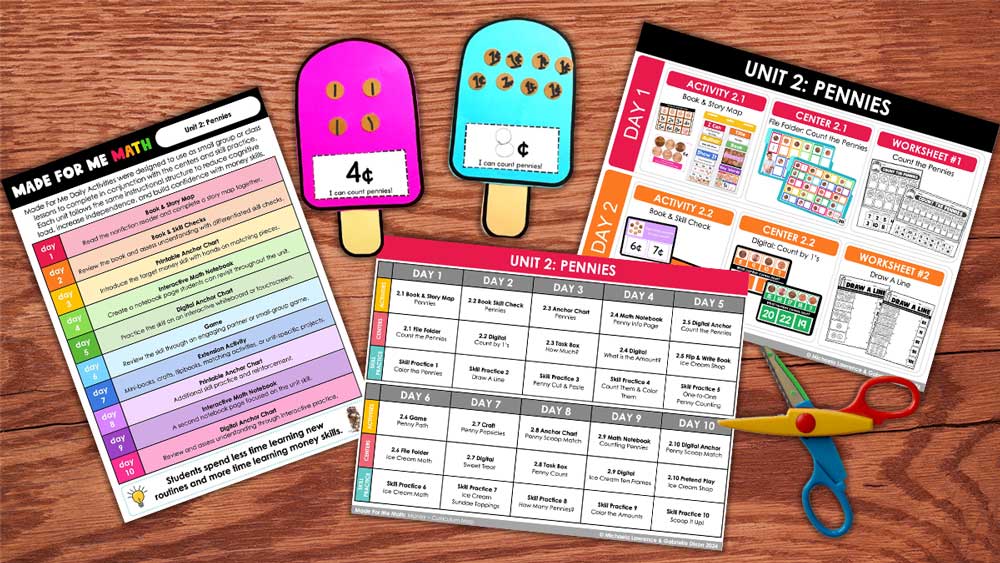
Each Made For Me Math: Money unit is designed to provide that kind of repeated exposure. Units include daily lesson plans, a student book, whole-group activities, printable centers, digital centers, and differentiated worksheets. The skill stays consistent while the format changes.
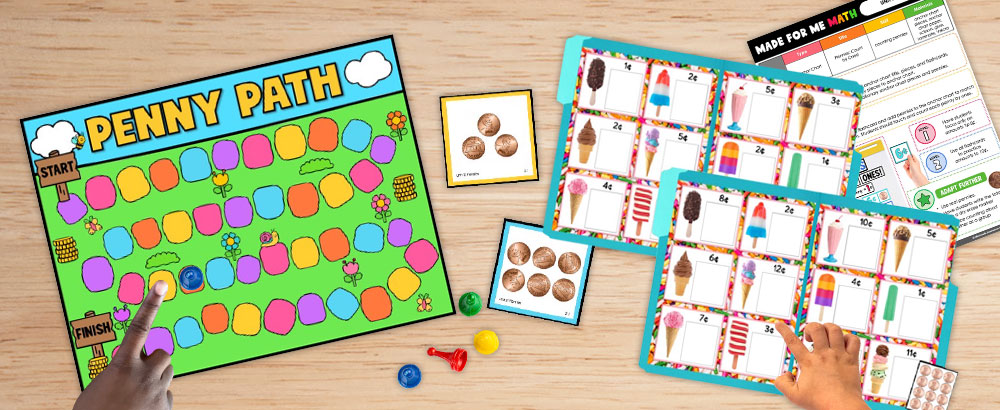
A student who practices a coin skill during teacher-led instruction and then meets it again in a task box or file-folder activity is doing more than repeating a worksheet. They are learning to recognize and use the concept in another setting.
Build Independence in Small Steps
Independence does not have to mean removing support all at once. It can begin with a student completing one familiar step with less help than before.
Money instruction gives us many chances to notice those changes. A student may begin by sorting with a model and later sort independently. They may first identify a penny from two choices and later recognize it among several coins. Small gains like these can support much more complex money tasks over time.
Breaking instruction into intentional steps also makes it easier for teachers to see what a student understands and where support is still needed. Students get more chances to be successful without being asked to juggle several new skills at the same time.
Keep the Bigger Goal in View
Teaching money skills one skill at a time does not mean keeping learning disconnected from real life. Strong foundational skills give students more tools for participating in everyday money experiences later.
The progression from Introduction to Coins to Pennies is only the beginning. The full Made For Me Math: Money bundle continues by adding one coin or combination at a time, then moves toward mixed coins, comparing amounts, and deciding whether a student has enough money to make a purchase.
That sequence gives each new skill somewhere to land. Instead of jumping directly to the most complicated money task, students have time to build the pieces that make the task possible.
Small Steps Can Lead to Bigger Money Skills
Money is a functional skill students can continue using throughout their lives, but instruction does not have to begin with complicated real-world problems. Sometimes the most useful thing we can do is make the next step smaller.
Giving students time to explore coins, focus on one coin, practice in different formats, and build independence gradually can make later money learning feel much more manageable.
The Made For Me Math: Money Bundle was designed around that progression, with slower pacing, explicit instruction, hands-on practice, repeated exposure, and multiple levels of differentiation. Explore the bundle if you are looking for a structured way to build money skills one step at a time.
Money Unit Release Schedule:
- Unit 1: Introduction to US Coins
- Unit 2: Counting Pennies
- Unit 3: Counting Nickels
- Coming November 1, 2026: Unit 4: Pennies and Nickels
- Coming December 1, 2026: Unit 5: Dimes
- Coming January 1, 2027: Unit 6: Pennies, Nickels, and Dimes
- Coming February 1, 2027: Unit 7: Quarters
- Coming March 1, 2027: Unit 8: Mixed Coins
- Coming April 1, 2027: Unit 9: Comparing Coin Amounts Up to $1.00
- Coming May 1, 2027: Unit 10 Do I Have Enough Money? (Coins Up to $1.00)

Leave a Reply